
Discover
Agree the business priorities, process scope, fit-to-standard decisions, and success measures.
SAP S/4HANA Cloud Public Edition connects core business processes. Erendi helps turn that capability into a working operating model—from fit-to-standard decisions to go-live and adoption.
Explore the questions behind cash collection, delivery commitments, purchasing, and financial traceability. Real screens from Erendi’s SAP demo environment.
Select a business question. Inspect the original screen.
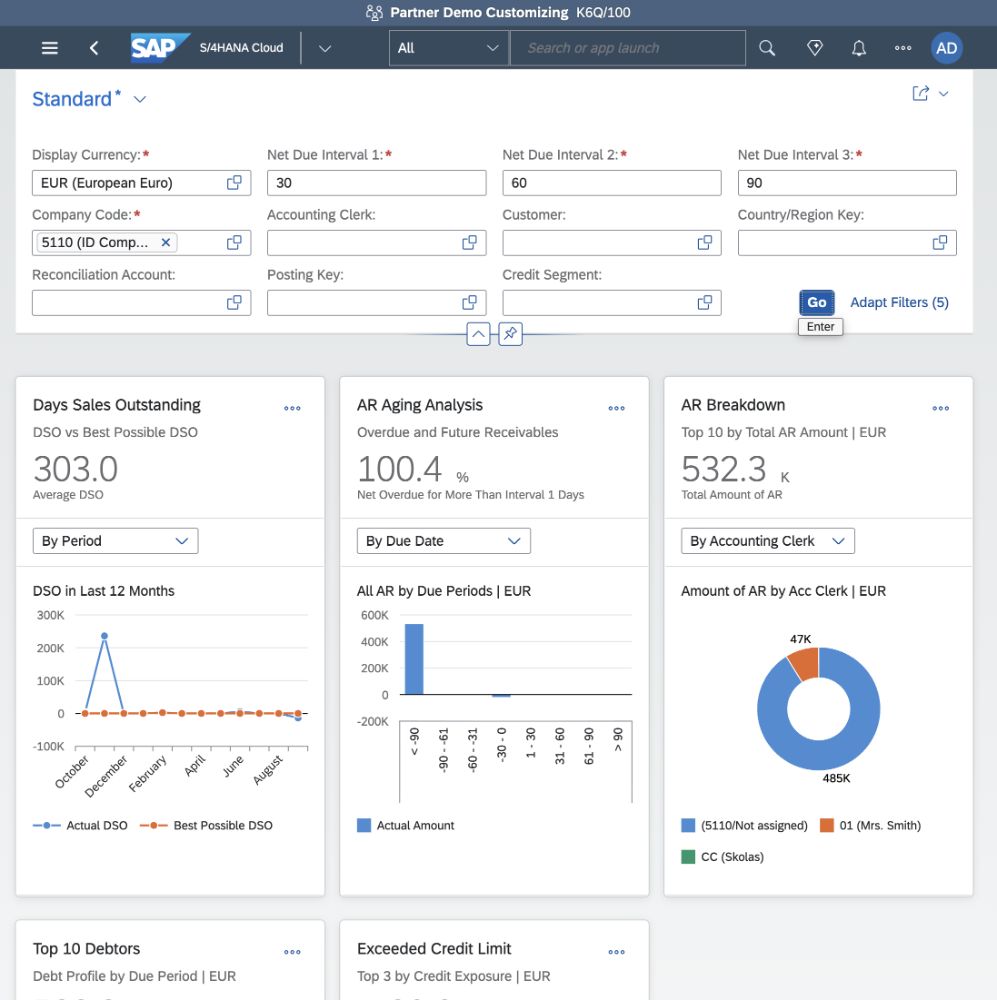
Sales alone do not tell the whole story. Put collection speed, overdue balances, and receivables exposure in the same conversation.
Compare actual DSO with the best-possible DSO trend.
See how receivables are distributed across due-date periods.
Break down receivables by accounting clerk to focus the review.
Which receivables should finance investigate first?
 Enlarge screenshot
 Illustrative demo balances, not customer performance or an improvement claim. The capture shows part of the overview.
Agree credit and collection responsibilities, reconcile opening balances, and validate reporting definitions with finance.
Bring the conversation between sales and operations back to the product, the date, and the supplying location.
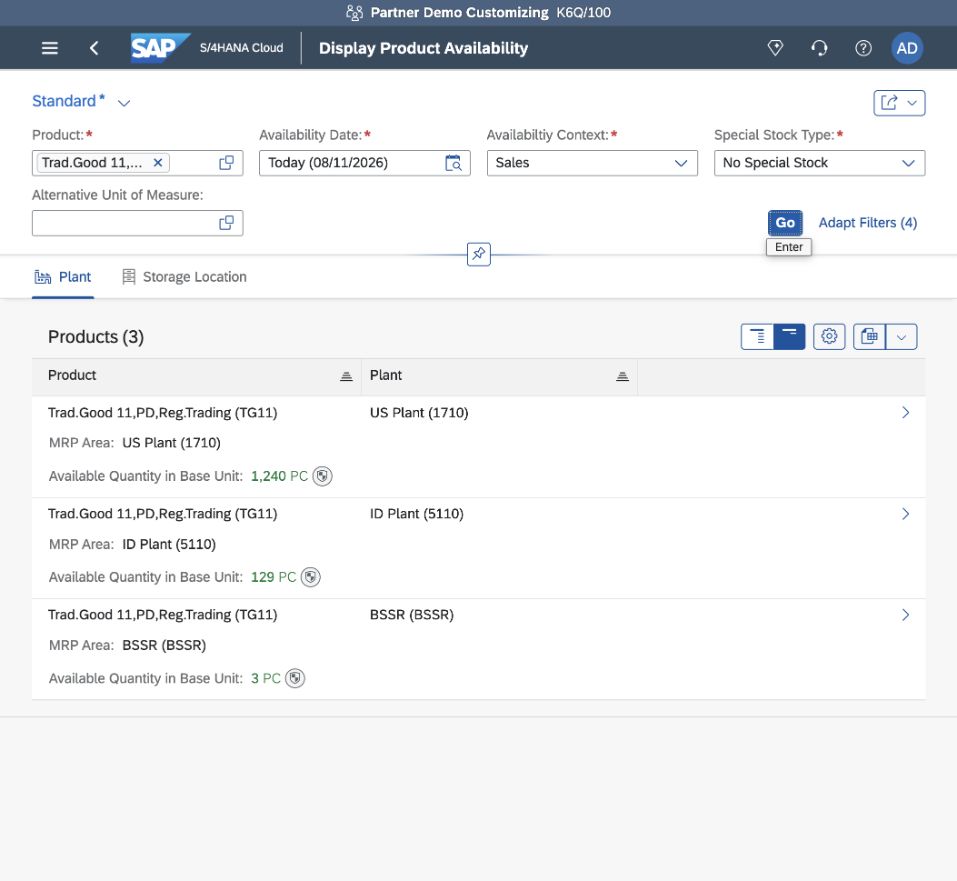
Set the product and availability date in the sales context.
Compare the displayed available quantities across locations.
Identify the plant whose availability needs a closer review.
Where should the team investigate supply before confirming a commitment?
 Enlarge screenshot
 A historical availability snapshot, not a current stock balance, confirmed sales order, or delivery guarantee.
Align plants, stock data, availability rules, and order-confirmation scenarios; test exceptions with sales and logistics.
Make purchasing commitments visible before they become disconnected spreadsheets, delivery issues, or invoice disputes.
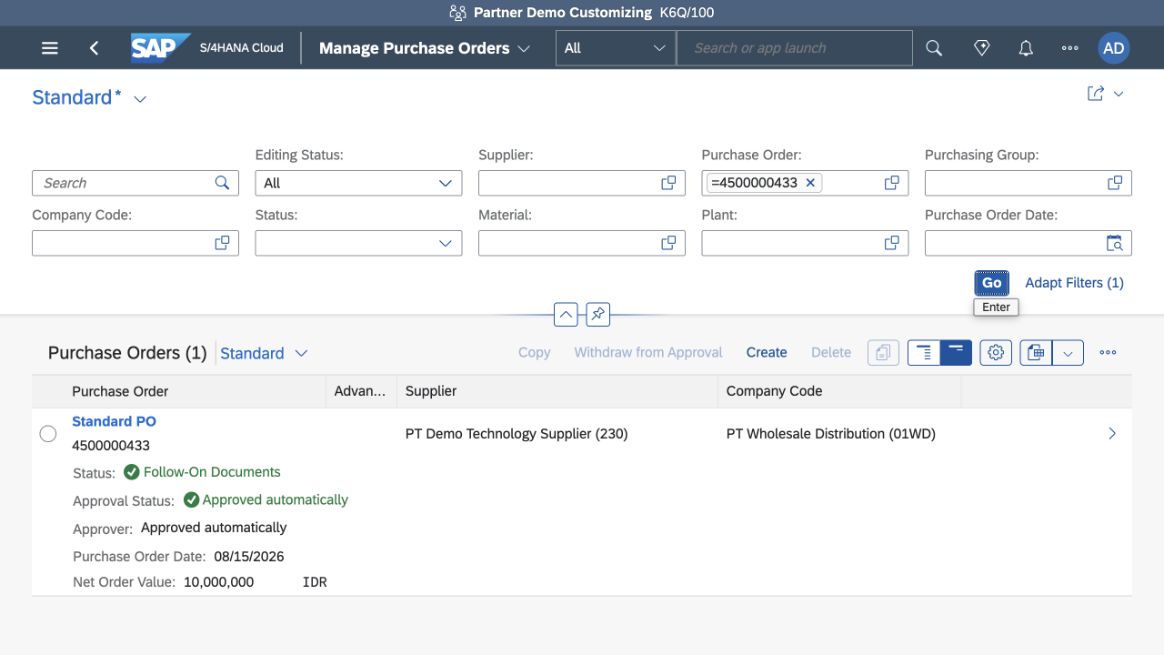
Review supplier, purchasing value, and organizational context.
Check the visible approval status before moving to the detail.
Use document indicators as a starting point for investigation.
Which commitment needs an approval or follow-up review?
 Enlarge screenshot
 The screenshot illustrates a purchasing worklist. It does not prove an entire approval, receipt, or payment cycle.
Define approval authority, purchasing responsibilities, and receipt/invoice controls; validate them with realistic exceptions.
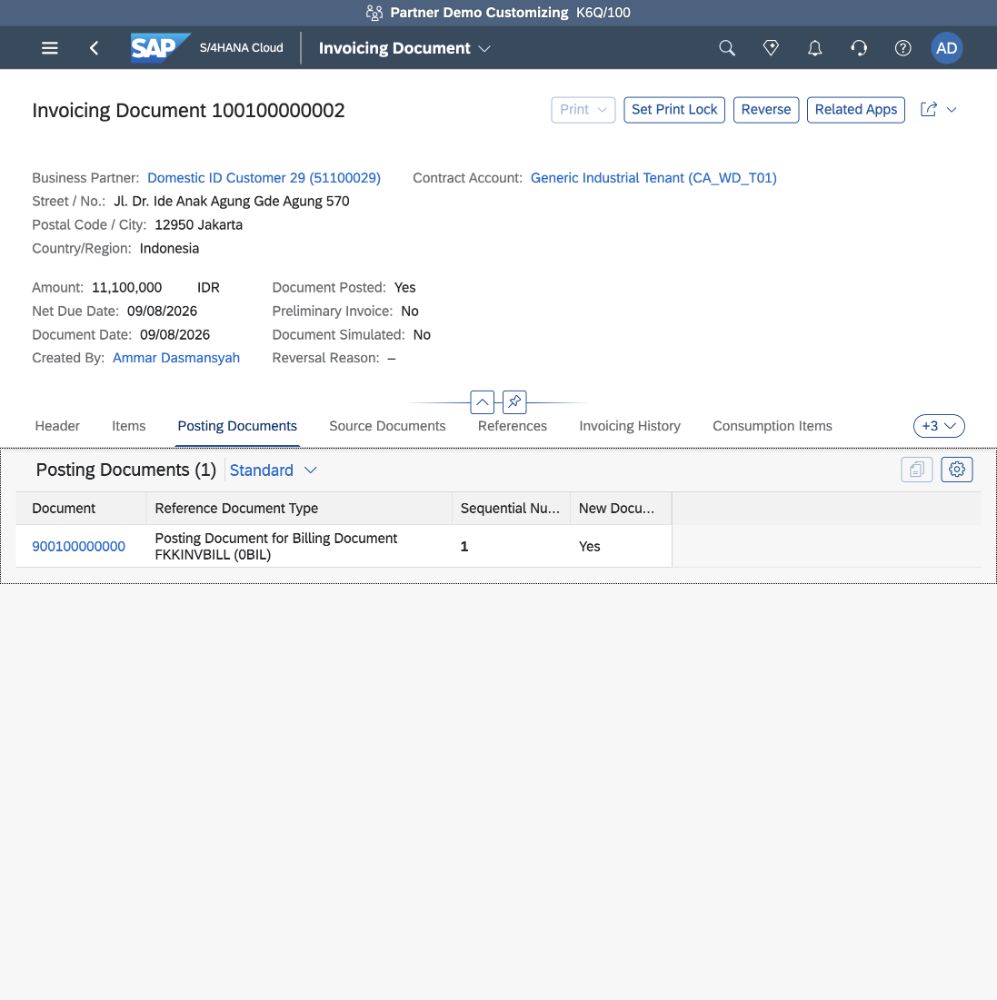
A document is more useful when finance can follow its references. This demo shows a contract invoice alongside its posting-document link.
Identify the business partner, amount, and posting status.
See the related posting document in the same application.
Follow the reference for a separate accounting review.
Which accounting document should finance inspect to reconcile the invoice?
 Enlarge screenshot
 Contract invoicing example, not an SD order-to-cash walkthrough. A posting reference is not evidence of payment or clearing.
Design the billing and accounting handoff, agree reconciliation checks, and confirm the relevant scope and entitlement.
Retained captures from Erendi TDD, not a live session or customer production system. These examples come from separate demo scenarios; they are not presented as one completed transaction chain. Screens and capabilities vary by release, role, configuration, and licensed scope.
Evaluate the handoffs—not just the individual apps. A scenario-led demo should explain how the commercial promise connects to logistics and finance.
Agree price, terms, and the customer commitment.
Check supply and execute delivery.
Record the inventory movement and its accounting impact.
Create the invoice and the related accounting entry.
Match the receipt and clear the receivable.
Illustrative process map—not a recording of the screenshots above. Exact steps and accounting depend on the agreed business scenario.
Consider SAP GROW when fragmented systems are limiting visibility and the business is ready to adopt standardized cloud ERP processes.
Do not choose on screenshots alone. Validate critical exceptions, subscription scope, and implementation readiness first.
The implementation must address data, controls, people, and integrations—not only system configuration. Agree responsibilities and acceptance criteria before the build.
Agree the business priorities, process scope, fit-to-standard decisions, and success measures.
Configure the agreed processes and roles; prepare migration and integration dependencies.
Reconcile data and test business scenarios—including exceptions—with the people who will run them.
Plan cutover, training, hypercare, and ownership of ongoing improvements.
Being new to SAP does not automatically rule out Private Cloud. Start with process fit, industry requirements, integration needs, and how much change your organization is ready to own.
Example: A distributor wants common finance, purchasing, inventory, and sales processes across its entities.
Explore SAP GROWExample: A company new to SAP has specialized production requirements that justify a Private Cloud assessment.
Explore SAP RISEPublic Cloud can support demanding businesses; Private Cloud is not a licence for unlimited customization. Compare the required scope, clean-core design, integrations, implementation effort, ongoing responsibilities, and total cost.
SAP Cloud ERP Private supports new implementations as well as transitions from existing SAP systems. SAP’s current RISE journey messaging emphasizes existing SAP customers. For a net-new customer, Erendi will assess Private Cloud fit and confirm the applicable commercial offering and eligibility with SAP before recommending a package.
References: SAP: Private Edition for net-new implementations ↗ · SAP: current RISE journey ↗
Discuss a scenario-led session with Erendi. Start with the process that matters to your investment decision—not a tour of every menu.
Plan a scenario-led demoA demo is not a fixed quote or a guarantee of savings. Build the business case from your baseline.